QAtlas curated demonstration
GHZ vs W
Two distinct three-qubit correlation structures in the same computational convention.
What this demonstration shows
GHZ and W states distribute probability and correlation differently across three qubits. Keeping the same computational convention makes their distinct structures easier to compare without turning either state into a literal object.
How to inspect it
Compare the populated bitstrings, selected ribbons, and labelled entropy. The visual comparison is descriptive; it does not replace state-level analysis.
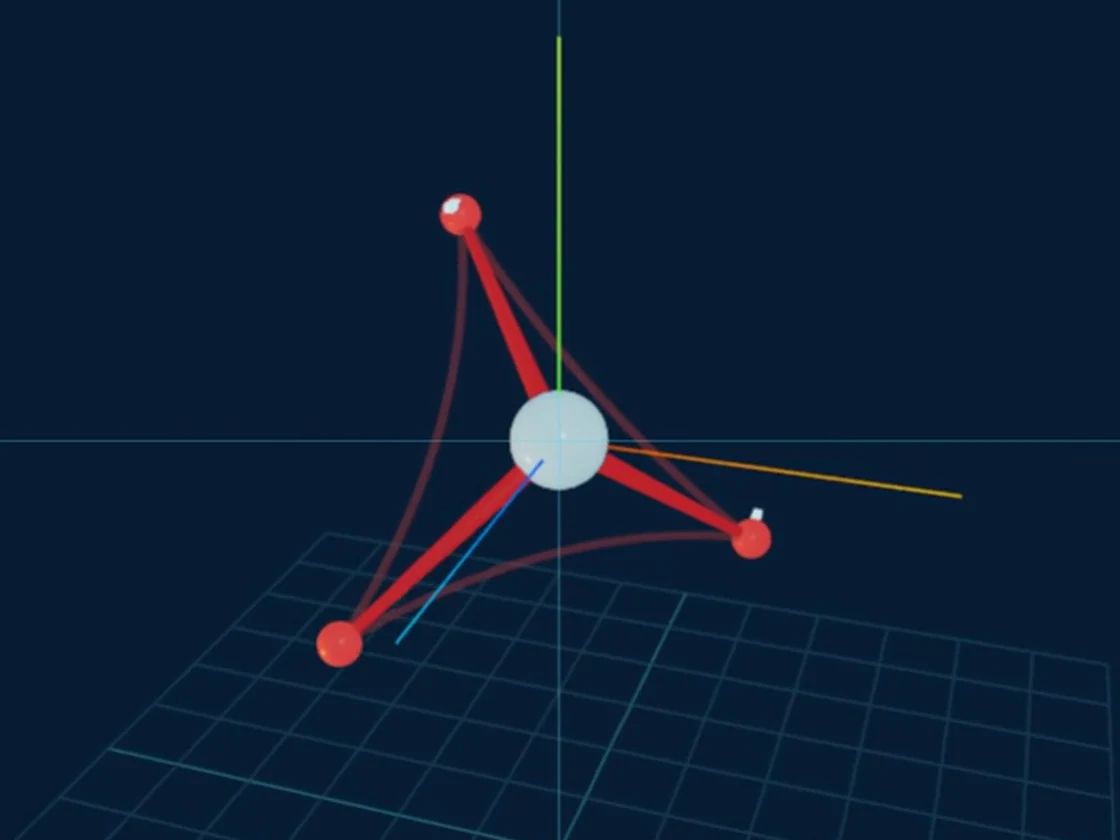
One excitation is shared across three qubits. Branch size shows probability; the phase marks and ribbons make the representation’s relationships inspectable.
Read the visual language- Purity
- 1.000
- Mixedness
- 0.000
- Entropy q₀|rest
- 1.000 bits
- Ribbons
- 1
Representation limitation. This sculpture is a deterministic explanatory encoding, not literal physical space. It is computational-basis dependent; visual similarity cannot establish state equivalence, entanglement, or operational fidelity.
OpenQASM 2.0 subset
Accepts qreg/creg, X/Y/Z/H/S/T/RX/RY/RZ/CNOT/CZ/SWAP, barriers, and terminal measurements only.
Timeline & measurement
Every gate produces an exact stored state. Discrete gates use a labelled visual transition; rotations can be interpreted as intermediate unitaries.
Export & share
Exports are generated from this same deterministic geometry. GLB contains representation metadata and is not a 3D-print claim.