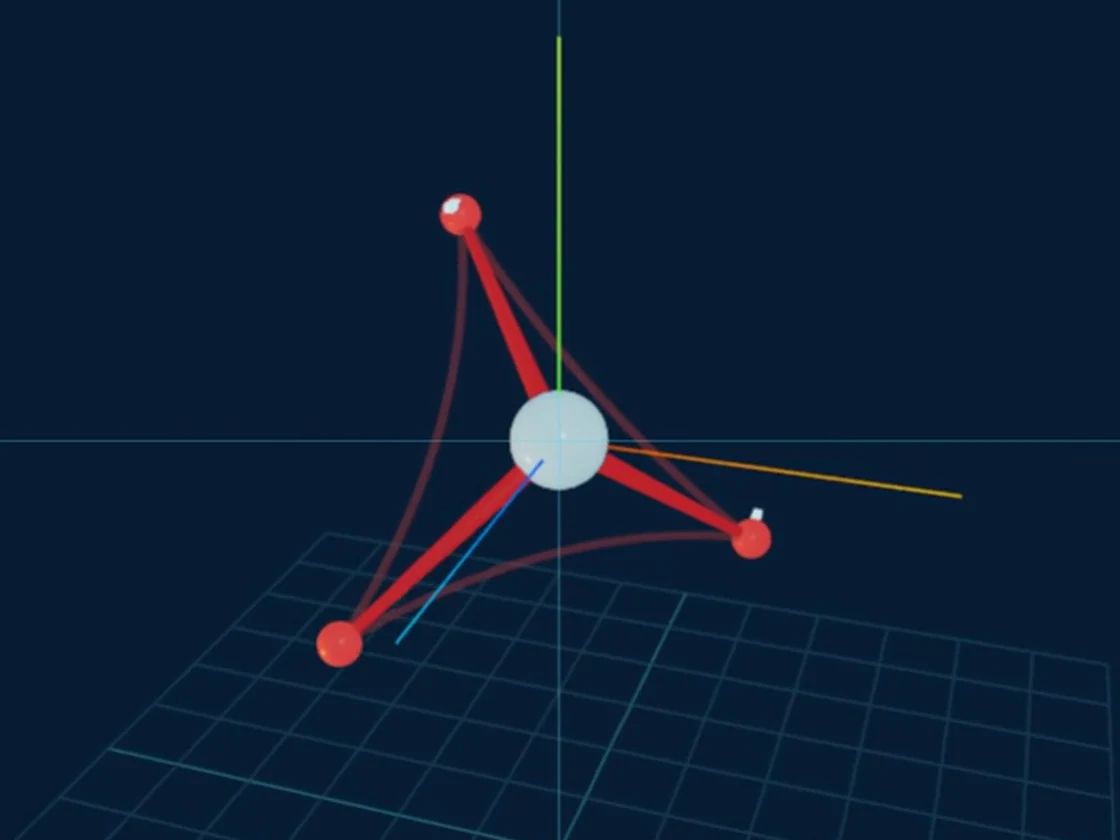
What does Quantum State Sculptor show?
Quantum State Sculptor is a transparent explanatory representation of a quantum state. It keeps the computational basis explicit: branch size encodes probability, phase marks encode relative phase, ribbons show selected coherence, and the inspector reports purity and a labelled subsystem entropy. It is useful for developers, researchers, educators, and advanced students who want to inspect state structure without treating a visual resemblance as physical proof. The sculpture is not literal quantum geometry, does not establish entanglement by appearance, and remains dependent on the selected computational basis.
Inputs and supported circuits
Use curated states, safe amplitude syntax, manual gates, or the documented OpenQASM 2 static-circuit subset. Inputs are parsed locally; arbitrary code, OpenQASM 3, and unsupported dynamic control are rejected clearly.
What the visual encodes
The representation exposes probability, relative phase, selected density-matrix coherence, purity, and the entropy of a disclosed first-qubit-versus-rest reduction. It keeps every mapping labelled rather than implying a universal spatial model.
Move between tools
Use Circuit X-Ray to inspect routing and hardware topology, or Noise Lab to run bounded local noise simulations. Compatible OpenQASM stays in this browser session.
Frequently asked questions
- Is this a literal picture of a quantum state?
- No. It is a deterministic visual language with disclosed computational-basis conventions and selected visual channels.
- Can the sculpture prove entanglement or state equivalence?
- No. Use the labelled mathematical metrics and the underlying state; visual similarity alone is not proof.
- Where are the representation details?
- Read the public State Sculptor methodology.